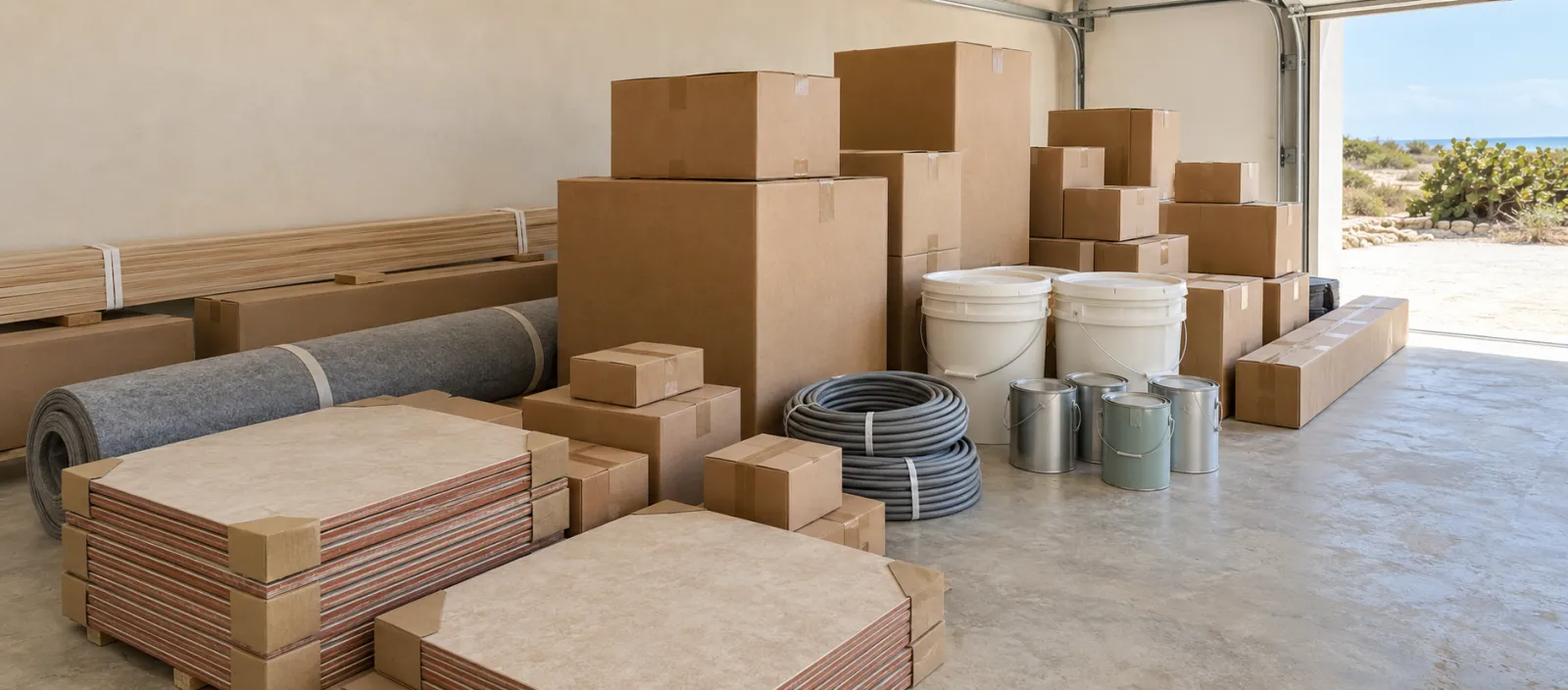
How you're billed
The ViaCube — our container: 58×42×45 in · 63 cubic feet · up to 1,200 lb
Fill it or half fill it — the fee is the same. Everything else is either what your goods cost to handle or what customs charges, passed straight through.
The fee belongs to the container, not the cargo — so everything that waits and travels together makes the same box cheaper. Fill a cube on your own and it is yours alone; share one and you split the fee by the space you use.
One real load weighed 376 lb of the 1,200 limit. Adding more to that container would not have raised the fee — it is the same however full the cube is.
Every rate, every edge case, every worked example: the FAQ.
Concierge
Outside the ordinary flow. All quoted before we start.
| We buy it for youSend the list. No markup on goods | 10%, min $150 |
| Fit-out coordinationA whole house, managed end to end | 5%, min $1,500 |
| Landed cost quoteFree up to 25 lines | $95 |
| Inspection against your order | $95 |
| Supplier liaisonVendors who refuse forwarders | $45 |
| Managed return to a supplierWe deal with the vendor and the paperwork | $85 |
| Custom cratingArt, glass, stone | $185 + materials |
| Removing packagingOften pays for itself in space | $65/hr |
| RushAn earlier sailing | $250 |
| A sailing of your own | $295 |
| Storage past 90 days | $50/pallet/mo |
No. Containers are shared — your goods travel with others', and your share of the space is what you pay for, invoiced per property. A half-room order and a whole-house fit-out both fit the model.
Nothing. Signing up is free and takes a couple of minutes. Your Miami address is issued once your account is activated, with a card on file; the first charge is when a shipment actually books.
A container costs us the same to book, load, ship and clear whether it leaves full or half empty. Charging by volume would mean pretending otherwise — and it would punish the customer who ships early in a project. The fee covers the container, so the sensible move is to let goods accumulate and travel together, which also makes the customs paperwork cleaner.
Every parcel that arrives is checked in, weighed, measured and recorded against the property it belongs to before it goes anywhere near a carton. That record is what makes per-property invoices possible at the end, rather than a pile reconstructed from memory. It's added to your account on arrival and billed when a shipment books.
Every package's first 30 days are free, counted from the day that package arrives. After that, $0.35 per cubic foot per day, with a 4 cubic foot minimum per item, capped at 90 days. Volume rather than per-package because our cargo is building and furnishing materials — a pallet of floor tile and a padded envelope don't cost the same to hold, and charging them alike would mean one customer subsidising another.
Every line on a customs entry needs an HS code, and choosing the right one decides what duty you pay. The first 80 line items on a shipment are included; beyond that, $4 per line. Eighty covers most container loads comfortably — a full villa fit-out with hundreds of distinct items goes past it, and that's real work priced as work rather than hidden in the container fee.
Three lines, in order: duty on the value at the rate for the goods' HS code (customs assesses on the CIF value at the border); the 1% Customs Service Fee on the dutiable value; and 9% import tax on value plus duty plus the fee — it compounds on the others rather than being a flat slice.
Worked example — a sofa bought for $2,400: duty at 15% is $360.00, the service fee is $24.00, and the import tax is 9% of $2,784 — $250.56. An estimate; customs makes the final assessment at the border. Arithmetic you can redo yourself is the point.
Anguilla import duty, 9% import tax, the 1% Customs Service Fee, broker clearance, port fees and island trucking. These aren't ours, and they reach you at the figure on the receipt, itemised. Never marked up, never folded into the container fee: a pass-through hidden inside a flat number is a margin nobody can find.
A few things are genuinely more work, quoted before we do them and never added after: a heavy item, 50–150 lb, $20; oversized, over 150 lb, $45; a very heavy container from about 1,000 lb, $150; collection, $85 covering an hour round trip then $65/hour; breaking down a supplier pallet, $65/hour; returns, $25; and a flat $35 per entry for settling duty and clearance on your behalf — flat, never a percentage, so it can never become a margin on your duty.
Free, deliberately: anything under 50 lb, and any pallet that arrives ready to travel. A pallet your supplier built properly is the cheapest thing we handle, so it's worth asking them to palletize.
Solvent-based paints, thinners, adhesives and aerosols are regulated dangerous goods and need a declaration from your supplier before we can accept them; water-based products are fine. Send the safety data sheet before you order and we'll tell you either way.
Yes — all quoted first: we buy it for you, no markup on the goods, 10% of goods value (min $150); fit-out project coordination end to end, 5% (min $1,500); a landed-cost quote before you buy, free to 25 lines then $95; inspection against your order with photos, $95; supplier liaison for vendors who won't ship to a forwarding address, $45; a managed return, $85; custom crating for art, glass or stone, $185 plus materials; removing packaging to save container space, $65/hour; a rush onto an earlier sailing, $250; a sailing of your own, off-schedule, $295; storage past 90 days by arrangement, $50 per pallet per month.
Once, by the volume each villa's goods occupy — never once per property. Each villa sees its share on its own invoice, which is the point of attributing goods to a property in the first place.
Because a single blended number cannot be checked. You can't tell whether the container cost more, whether duty was passed on honestly, or whether a margin quietly widened — and neither can the owner asking why a fit-out cost what it did. Kept apart, every line answers to something outside us: a published tariff schedule, a broker's receipt, a port invoice. That's what makes a bill defensible rather than believable.
Yes. The best test of any of this is a genuine invoice with the lines showing — tell us what you ship and we'll walk you through one.
Because they're paying for different things. Freight splits by volume — space on a ship is what you're buying, so space is what you're billed for. Duty splits by value — that's how customs values each line. Both are correct for their own purpose, and forcing them into one tidy number is exactly what makes a forwarder's invoice impossible to check.
Questions about what actually happens to a box are on /how-it-works.
Signing up is free and takes a couple of minutes. Nothing is charged until a shipment books.
Get my Miami address →Rather talk first? Call 305-403-9531 or email hello@islandvia.com.